
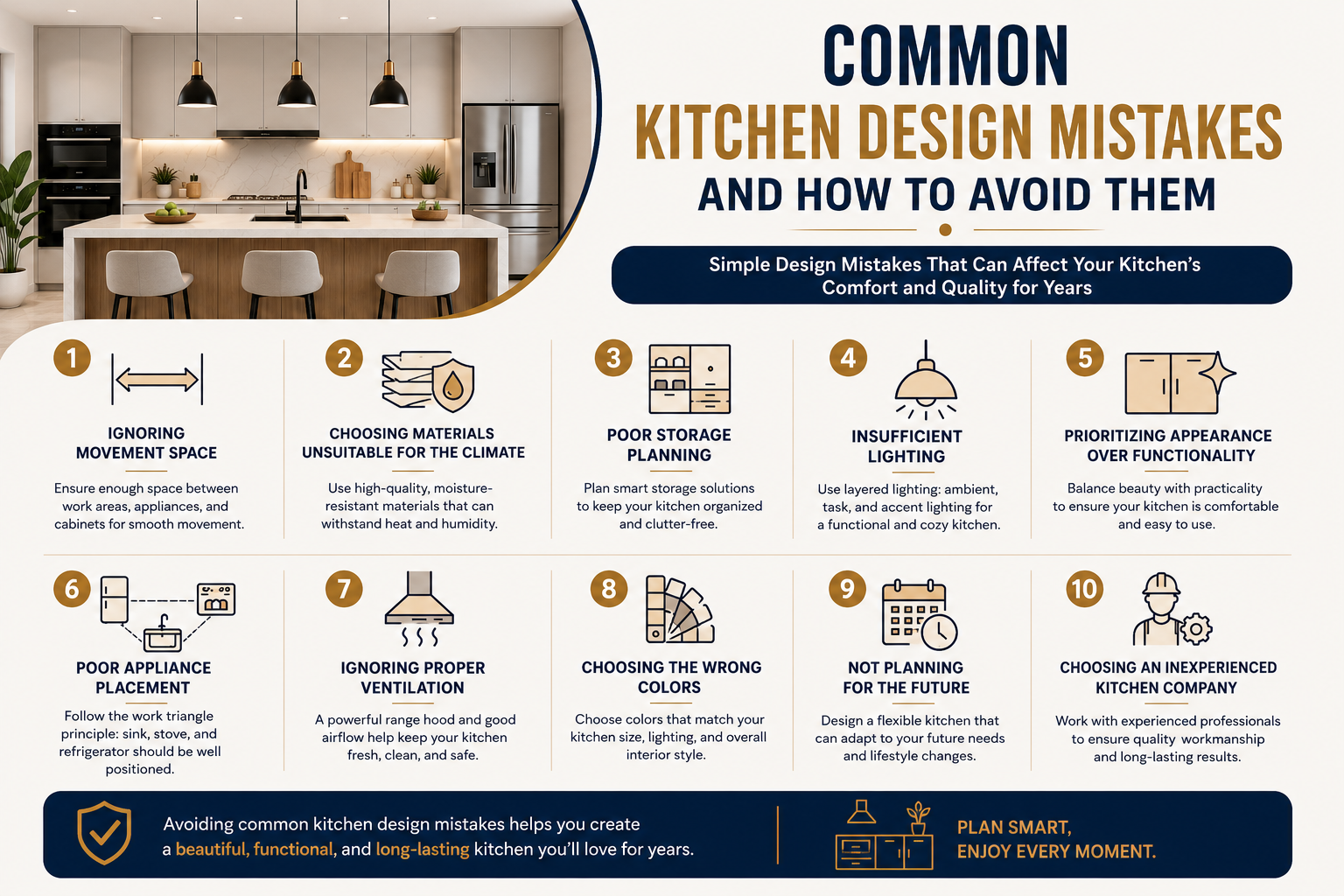
Kitchen design is not only about beautiful colors and stylish finishes. A successful kitchen must also be practical, functional, comfortable, and suitable for everyday use. Many homeowners unintentionally make design mistakes that later affect the kitchen’s efficiency, storage capacity, and long-term durability.
In this article, we explore the most common kitchen design mistakes and how to avoid them when planning a modern kitchen.
One of the most common mistakes is designing a beautiful kitchen that feels uncomfortable to use.
Narrow spaces between:
Can make daily movement difficult and frustrating.
Ensure enough space between:
To create smooth workflow and comfortable movement.
In UAE and Gulf homes, heat and humidity heavily affect kitchen durability.
Poor-quality materials may lead to:
Use durable materials such as:
Many kitchens look attractive but lack enough storage space.
This often leads to:
Focus on:
Poor lighting makes kitchens feel less functional and less luxurious.
Common mistakes include:
Use:
Some kitchens look stunning in photos but are difficult to use daily.
Examples include:
Choose a design that balances:
Incorrect appliance positioning can make kitchen movement inefficient.
Examples include:
Follow the “work triangle” principle connecting:
In a practical layout.
Ventilation is essential in modern kitchens.
Poor ventilation may cause:
Install a powerful ventilation hood suitable for the kitchen size and improve natural airflow whenever possible.
Very dark colors can make small kitchens feel smaller.
Lighter tones help:
Choose colors based on:
Some kitchens are designed only for current needs.
Over time, changes may occur in:
Choose flexible layouts that allow future additions such as:
Even the best design can fail because of poor execution.
Bad installation may lead to:
Choose a company with proven experience and high-quality completed projects.
Poor storage planning, bad appliance placement, and insufficient lighting are among the most common mistakes.
Yes. Open kitchens need better coordination with surrounding living spaces in terms of layout, colors, and materials.
Absolutely. Choosing materials suitable for climate and daily use greatly improves durability.
By improving storage, optimizing workflow, and carefully planning appliance placement and work areas.
A successful kitchen design is not just about appearance — it is about balancing beauty, practicality, comfort, and long-term usability. Avoiding common kitchen design mistakes can help create a kitchen that remains functional, organized, and visually appealing for many years.
Investing in smart planning, durable materials, and experienced professionals can make a major difference in the final result.


